
We analyzed connected medical device security platforms serving healthcare delivery organizations and evaluated the top eight solutions using five critical ranking factors: IoMT Protection Coverage, Hospital Deployment Success, Compliance & Regulatory Support, Threat Detection Capabilities, and Operational Integration. Our analysis prioritized vendors with proven healthcare experience and enterprise-scale deployments.
Ranking Algorithm
- IoMT Protection Coverage (25%): The breadth and depth of connected medical device visibility, including passive discovery and asset classification accuracy.
- Hospital Deployment Success (25%): Proven track record of successful implementations in healthcare delivery organizations, measured by customer satisfaction scores and deployment timeframes.
- Compliance & Regulatory Support (20%): Capabilities supporting HIPAA, FDA premarket cybersecurity guidance, and HHS 405(d) requirements.
- Threat Detection Capabilities (20%): Real-time monitoring for anomalous device behavior. Covers zero-day threat identification and ransomware protection. Must detect threats without generating excessive false positives.
- Operational Integration (10%): Seamless integration with existing healthcare IT infrastructure, including CMMS platforms and EHR systems. Covers API quality and pre-built connectors.
2026 Medical Device Security Rankings
Rank | Solution | IoMT Coverage | Deployment Success | Compliance Support | Threat Detection | Integration |
|---|---|---|---|---|---|---|
1 | Exceptional | Outstanding | Comprehensive | Advanced | Extensive | |
2 | Exceptional | Excellent | Comprehensive | Advanced | Extensive | |
3 | Excellent | Excellent | Strong | Strong | Good | |
4 | Strong | Good | Good | Strong | Excellent | |
5 | Strong | Good | Good | Good | Good | |
6 | Good | Moderate | Good | Strong | Excellent | |
7 | Good | Emerging | Good | Good | Good | |
8 | Moderate | Moderate | Moderate | Moderate | Specialized |
2026 Medical Device Security Rankings: Descriptions & Reviews
1. ORDR AI Protect Platform
ORDR delivers comprehensive medical device security through its Systems Control Engine (SCE), providing automated asset discovery and AI-powered threat detection across IoMT environments. The platform's agentless architecture ensures zero disruption to clinical operations while maintaining complete device visibility.
- IoMT Coverage: Exceptional passive discovery capabilities with deep protocol analysis covering 60+ healthcare-specific protocols
- Deployment Success: Outstanding implementation record with major health systems, typically deployed within 4-6 weeks
- Compliance Support: Comprehensive HIPAA compliance reporting with automated policy enforcement. Includes FDA guidance alignment.
- Threat Detection: Advanced behavioral analytics with AI-driven anomaly detection. Features automated incident response orchestration.
- Integration: Extensive ecosystem including ServiceNow and Splunk. Also integrates with Cisco ISE and major CMMS platforms.
Summary of Online Reviews |
|---|
ORDR customers highlight the platform's "intuitive interface" and "rapid deployment without network disruption." Healthcare organizations consistently praise the "granular device visibility" and "actionable risk prioritization." |
2. Claroty xDome for Healthcare (Medigate)
Claroty xDome, powered by the Medigate platform, has won Best in KLAS for Healthcare IoT Security five consecutive years (2021-2026). The SaaS-based solution provides purpose-built medical device security with healthcare-specific asset intelligence.
- IoMT Coverage: Exceptional device classification with clinical context, including FDA class and recall status. Provides clinical criticality scoring.
- Deployment Success: Excellent track record with 300+ healthcare providers protecting over 10 million devices across 42,000 facilities
- Compliance Support: Comprehensive regulatory alignment with automated compliance reporting. Features device risk assessment dashboards.
- Threat Detection: Advanced anomaly detection with Team82 threat intelligence. Includes automated alert correlation.
- Integration: Extensive partnerships, including Cisco and Fortinet. Also integrates with CrowdStrike and major HTM platforms such as Nuvolo.
Summary of Online Reviews |
|---|
Claroty customers describe the platform as "the gold standard for healthcare IoT security." Reviews consistently mention "exceptional customer support" and "healthcare-specific features that understand clinical workflows." |
3. Asimily
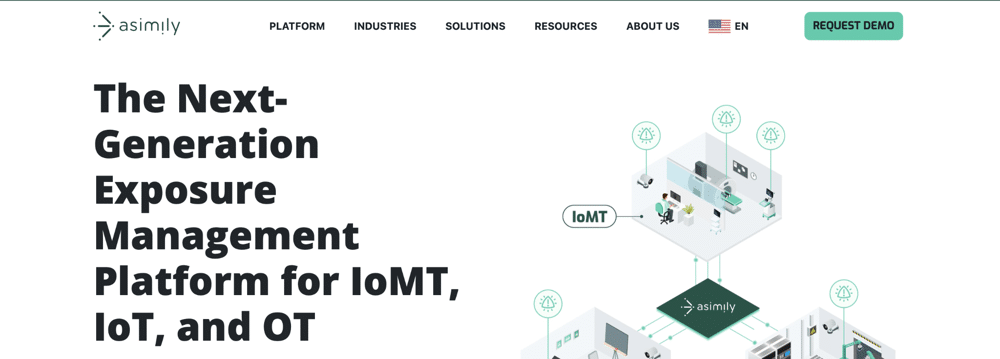
Asimily provides next-generation cyber asset and exposure management designed specifically for large hospitals with thousands of connected devices. The platform emphasizes risk-based prioritization and automated remediation workflows.
- IoMT Coverage: Excellent passive monitoring with comprehensive device profiling. Includes vulnerability correlation capabilities.
- Deployment Success: Excellent customer satisfaction ratings with proven success in health systems managing 10,000+ devices
- Compliance Support: Strong compliance frameworks with automated vulnerability tracking. Features remediation documentation.
- Threat Detection: Strong behavioral analysis with machine learning-based threat detection. Provides 24/7 monitoring capabilities.
- Integration: Good ecosystem integration with major security platforms. Connects with CMMS systems.
Summary of Online Reviews |
|---|
According to KLAS Research 2026, Asimily demonstrates "high market energy" with customers praising "streamlined workflows" and "actionable intelligence." Healthcare CISOs highlight the platform's ability to "drive measurable risk reduction." |
4. Armis Centrix
Armis Centrix for Medical Device Security delivers comprehensive asset visibility through agentless discovery across IT environments. The platform emphasizes patient-centric cyber exposure management and real-time risk assessment.
- IoMT Coverage: Strong multi-protocol device discovery with extensive device fingerprinting capabilities
- Deployment Success: Good implementation record with focus on large healthcare systems. Serves academic medical centers.
- Compliance Support: Good regulatory alignment with policy templates. Features compliance dashboards.
- Threat Detection: Strong threat intelligence integration with Armis Asset Intelligence Engine for behavioral analysis
- Integration: Excellent ecosystem with broad SIEM integrations. Also connects with SOAR and infrastructure platforms.
Summary of Online Reviews |
|---|
KLAS Research 2026 notes Armis shows "mixed market energy" with customers highlighting "comprehensive device visibility" and "strong integration capabilities." |
5. Forescout (CyberMDX)
Forescout acquired CyberMDX in 2022 to strengthen healthcare IoMT capabilities. The Forescout 4D Platform combines network access control with medical device security to deliver asset intelligence and risk assessment.
- IoMT Coverage: Strong device discovery using multiple passive techniques. Features cloud-powered classification with active methods.
- Deployment Success: Good deployment record with 300+ healthcare customers managing 10M+ devices across 600M annual patients
- Compliance Support: Good compliance capabilities, including HIPAA alignment. Tracks FDA recall status.
- Threat Detection: Good multi-stage threat detection with a five-technique blend to reduce false positives
- Integration: Good integration ecosystem with network infrastructure vendors. Connects with security platforms.
Summary of Online Reviews |
|---|
Frost & Sullivan recognized Forescout with the 2025 Global Medical Device Security Product Leadership Award. Customers appreciate the "comprehensive risk scoring" and "network segmentation capabilities." |
6. Palo Alto Networks Medical IoT Security
Palo Alto Networks extends its cybersecurity platform to medical IoT with capabilities for device discovery and risk assessment. Integration with the company's next-generation firewalls provides policy enforcement.
- IoMT Coverage: Good device identification leveraging Palo Alto Networks' threat intelligence. Features device behavioral analysis.
- Deployment Success: Moderate healthcare-specific deployment track record as the company expands its healthcare focus
- Compliance Support: Good regulatory framework alignment with policy recommendations. Includes compliance reporting.
- Threat Detection: Strong threat prevention capabilities leveraging WildFire malware analysis. Features AI-powered security.
- Integration: Excellent integration within the Palo Alto Networks ecosystem, including Prisma Cloud. Also connects with Cortex platforms.
Summary of Online Reviews |
|---|
Healthcare organizations that use Palo Alto Networks infrastructure appreciate its "unified security approach." KLAS Research 2026 notes customers desire "more proactive guidance for complex solutions." |
7. Axonius (Cynerio)
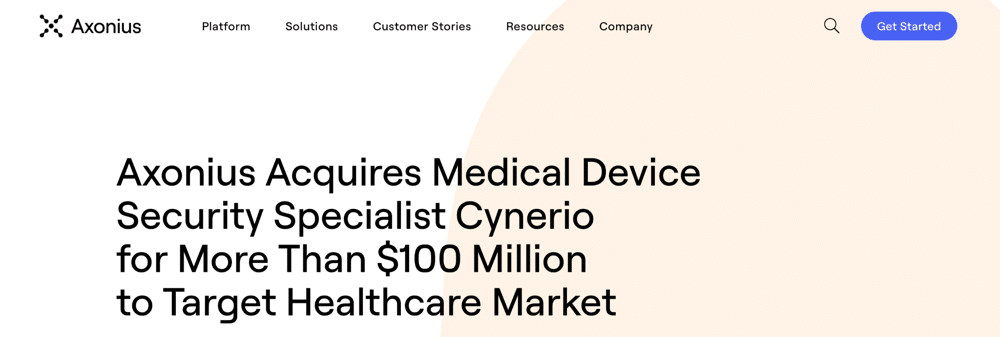
Axonius acquired medical device security specialist Cynerio in July 2025 for over $100 million to accelerate its expansion in the healthcare market. The combined platform extends Axonius' cyber asset attack surface management to healthcare IoMT environments.
- IoMT Coverage: Good medical device visibility with healthcare-specific asset intelligence from Cynerio's heritage
- Deployment Success: Emerging combined platform deployment record as integration progresses post-acquisition
- Compliance Support: Good compliance capabilities with automated device inventory. Features risk assessment.
- Threat Detection: Good anomaly detection with policy enforcement. Includes incident response automation.
- Integration: Good integration capabilities leveraging Axonius' broad technology ecosystem partnerships
Summary of Online Reviews |
|---|
Early reviews of the combined platform highlight "promising integration potential" and "comprehensive asset management approach." Pre-acquisition Cynerio customers praised the "clinical context" and "ease of use." |
8. Elisity
Elisity provides identity-based microsegmentation designed for Zero Trust network security across healthcare environments. The platform focuses on network segmentation without requiring extensive infrastructure changes.
- IoMT Coverage: Moderate device discovery capabilities focused on identity-based classification for segmentation policies
- Deployment Success: Moderate healthcare deployment footprint with focus on organizations implementing Zero Trust architectures
- Compliance Support: Moderate compliance capabilities aligned with network segmentation requirements for regulations
- Threat Detection: Moderate threat detection focused on lateral movement prevention through microsegmentation
- Integration: Specialized integration with network infrastructure for policy enforcement without hardware changes
Summary of Online Reviews |
|---|
Healthcare customers implementing Zero Trust strategies highlight Elisity's "operationally sustainable microsegmentation" and "zero-downtime implementation." Users note the platform "doesn't add operational overhead." |
Top Solutions for Specific Use Cases
These top platforms are tailored to meet the unique needs of healthcare providers, whether they manage large-scale operations or ensure regulatory compliance.
Best for Large Health Systems (500+ Beds)
Solution | Key Highlight |
|---|---|
Proven scalability across 300+ health systems with 10M+ devices | |
Enterprise-grade automation with advanced AI capabilities | |
Purpose-built for large hospitals with thousands of connected devices | |
Comprehensive platform managing 600M annual patients across deployments |
Best for Compliance-Focused Organizations
Solution | Compliance Capability |
|---|---|
Automated compliance reporting for multiple healthcare regulations | |
Best-in-class compliance dashboards with audit capabilities | |
Strong vulnerability tracking with remediation documentation | |
Comprehensive policy templates with regulatory alignment |
To request a comprehensive comparison PDF of these solutions tailored to your specific healthcare environment, contact us here.
Request Enterprise Comparison