
We evaluated 27 network segmentation tools from leading vendors and identified eight solutions that excel in automated policy enforcement, protection of legacy devices, deployment speed, and zero-trust architecture. Our analysis included architecture approaches, enforcement models, compatibility with unmanaged devices, and time-to-value metrics.
Ranking Algorithm
- Architecture Approach (25%): Network-native segmentation avoids bottlenecks and enforces policies at the switch level, unlike firewalls or agents, which can disrupt operations or fail on legacy systems.
- Legacy Device Compatibility (25%): Top solutions secure devices without agents, covering medical, OT, and IoT assets that make up 40% to 60% of environments.
- Deployment Timeline (20%): Faster implementations (weeks vs. months) reduce risk sooner, with simulation tools preventing policy errors before enforcement.
- Automation Level (15%): AI-driven policy creation and continuous adaptation reduce manual effort and ongoing maintenance.
- Integration Ecosystem (15%): Strong integrations with tools like Cisco ISE, Palo Alto, and CrowdStrike enable unified security across systems.
Best Network Segmentation Tools, 2026
Rank | Tool | Architecture | Legacy Support | Deployment | Automation | Integrations |
|---|---|---|---|---|---|---|
1 | Agentless / AI-driven | Excellent | Rapid | High | Extensive | |
2 | Identity-based edge | Excellent | Rapid | High | Strong | |
3 | Agent + agentless hybrid | Moderate | Standard | High | Extensive | |
4 | Agent-based primary | Limited | Standard | Moderate | Strong | |
5 | Network access control | Good | Extended | Moderate | Cisco-focused | |
6 | Multi-model | Good | Standard | High | Strong | |
7 | NAC with segmentation | Good | Extended | Moderate | Extensive | |
8 | MFA-triggered agentless | Moderate | Rapid | High | Limited |
Best Network Segmentation Tools, 2026: Descriptions & Reviews
1. ORDR
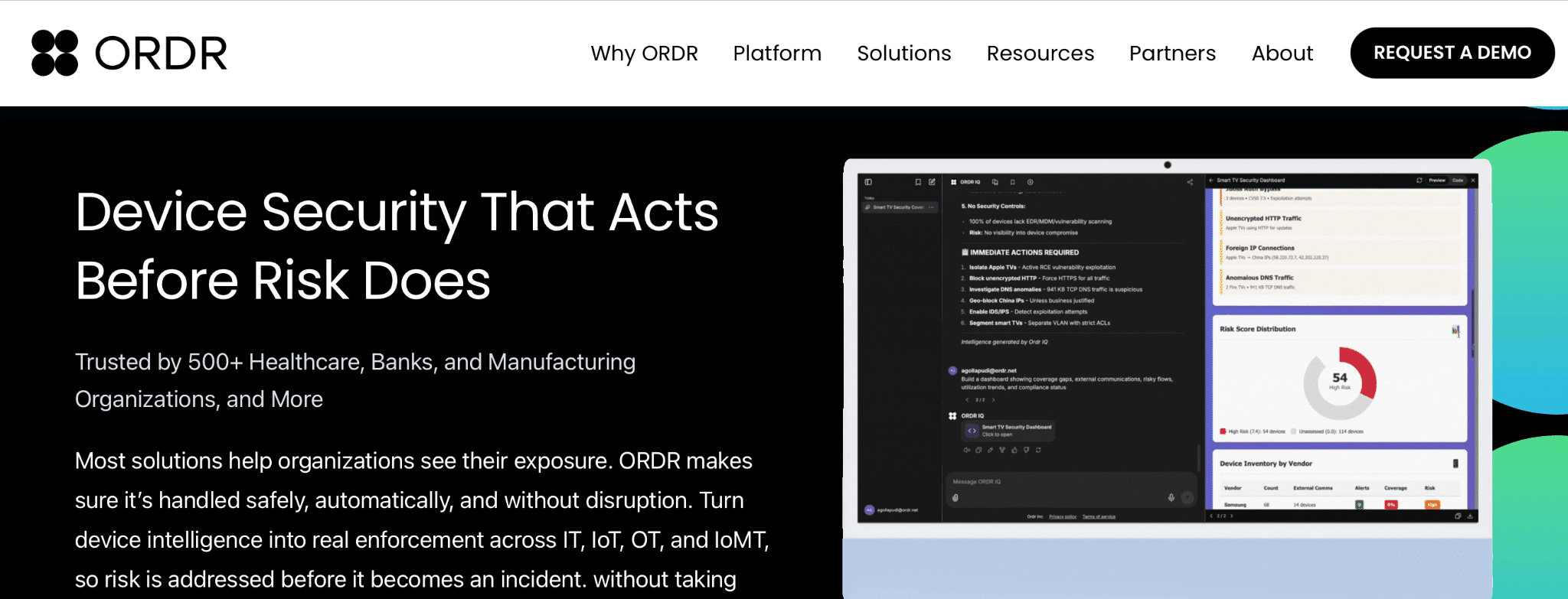
ORDR delivers AI-driven segmentation that transforms device intelligence into automated policy enforcement. The platform's behavioral modeling creates policies from observed traffic patterns rather than manual configuration. ORDR generates policies automatically using AI and integrates with major firewall vendors without requiring overlay networks.
- Architecture Approach: Agentless behavioral analysis with multi-vendor firewall enforcement through Cisco, Palo Alto Networks, Fortinet, and Aruba ClearPass integration
- Legacy Device Compatibility: Native support for IoT, OT, IoMT devices through passive network observation without agents
- Deployment Timeline: Visibility within 24-48 hours, with policy generation beginning immediately after baseline establishment
- Automation Level: ORDR IQ orchestrates multi-agent AI for threat triage, Zero Trust policy generation, and automated segmentation enforcement
- Integration Ecosystem: Connects to Cisco ISE, Aruba ClearPass, Forescout, Splunk, IBM QRadar, and Microsoft Sentinel
Summary of Online Reviews |
|---|
ORDR is recognized for "accelerating segmentation from discovery to enforcement" faster than competing platforms. Healthcare and manufacturing customers highlight the platform's "ability to protect medical devices and industrial systems." |
2. Elisity
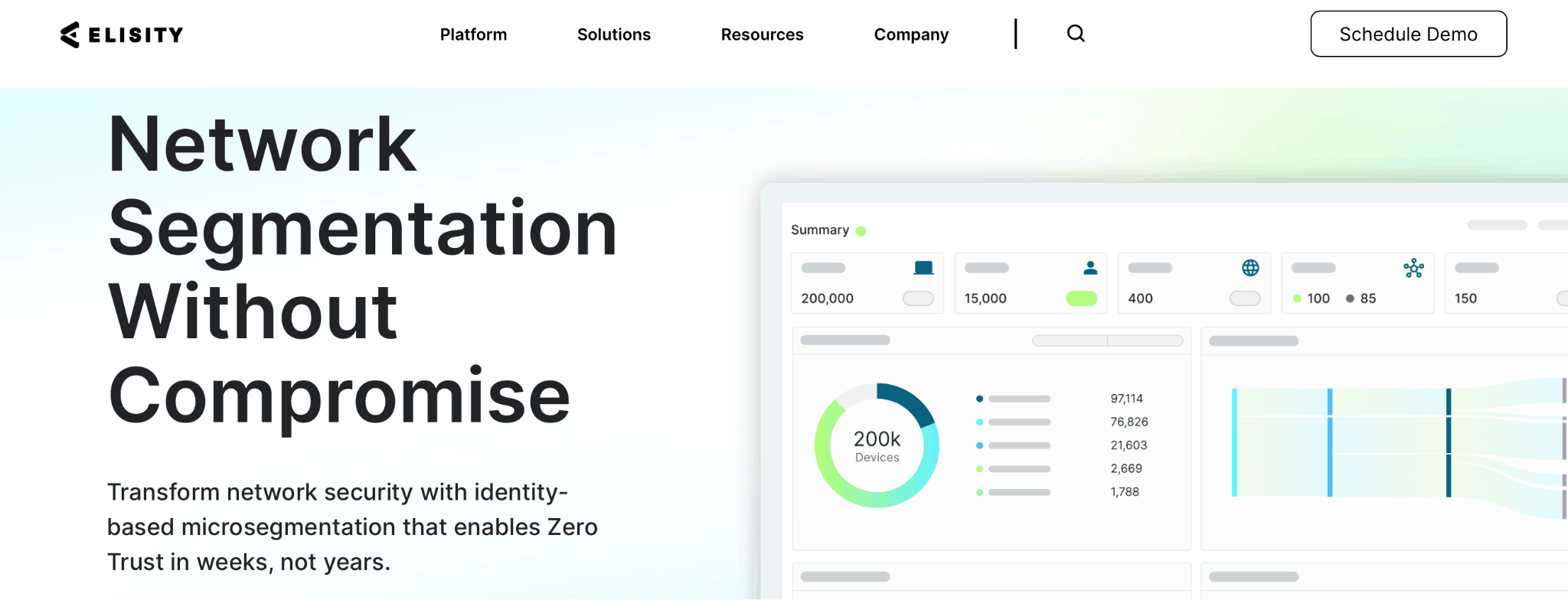
Elisity enforces identity-based segmentation at existing network switches using Virtual Edge technology. No agents, overlays, or hardware replacements required. IdentityGraph fuses data from Active Directory, CMDBs, EDR platforms, and CPS tools into unified identity profiles that drive policy.
- Architecture Approach: Network-edge enforcement leveraging existing switch infrastructure with identity-based policy control
- Legacy Device Compatibility: Agentless discovery across IT, OT, IoT, IoMT environments with enforcement at the network layer
- Deployment Timeline: Implementation completes within weeks rather than months, with no network downtime required
- Automation Level: Automated asset classification and identity mapping with policy recommendations based on device roles
- Integration Ecosystem: Connects with CrowdStrike, SentinelOne, Claroty, Armis, Nozomi, ServiceNow, and existing switches
Summary of Online Reviews |
|---|
Users praise Elisity for "eliminating hardware replacement costs" while "achieving comprehensive coverage of legacy OT and IoT devices." Healthcare organizations cite "accelerated HIPAA and IEC 62443 compliance." |
3. Illumio
Illumio pioneered workload-centric microsegmentation by deploying the VEN agent across data centers and hybrid cloud environments. February 2026 launch of Illumio Insights adds agentless visibility by ingesting firewall telemetry from Check Point and Fortinet. AI-driven policy recommendations, combined with real-time traffic visualization.
- Architecture Approach: Agent-based enforcement on workloads with new agentless visibility through firewall telemetry ingestion
- Legacy Device Compatibility: Core enforcement requires agents with monitoring-only capability for unmanaged OT/IoT devices
- Deployment Timeline: Agent rollout typically requires a standard deployment timeline for full coverage across large environments
- Automation Level: Automated application dependency mapping with AI-driven policy recommendations and label-based abstraction
- Integration Ecosystem: Broad cloud platform support across AWS, Azure, GCP, with container orchestration for Kubernetes and OpenShift
Summary of Online Reviews |
|---|
Organizations with virtual infrastructure cite Illumio's "strong workload-level visibility and simplified policy management" through label-based models. Some note agent requirements "limit coverage of physical and legacy devices." |
4. Akamai Guardicore Segmentation
Akamai's platform combines microsegmentation with built-in threat hunting, DNS firewall, and reputation analysis through a hybrid deployment model. Primary enforcement through host-based agents with agentless support for Azure and AWS PaaS resources. Threat-hunting integration automatically correlates segmentation breaches with attack indicators, providing unified visibility.
- Architecture Approach: Host-based agent enforcement with proprietary firewall installation and agentless PaaS support
- Legacy Device Compatibility: Agent-based model with agentless cloud-native workload coverage, but limited OT/IoT protection
- Deployment Timeline: Standard deployment for agent rollout with faster cloud environment implementation through PaaS integration
- Automation Level: Automated threat correlation with segmentation events and traffic-based policy suggestions
- Integration Ecosystem: Deep Azure and AWS integration with DNS firewall and reputation databases built into a unified platform
Summary of Online Reviews |
|---|
Users value Akamai Guardicore's combined segmentation and threat hunting capabilities delivered through a single console. Data center-focused organizations praise the platform's "east-west visibility and native AWS and Azure integration for hybrid environments." |
5. Cisco ISE
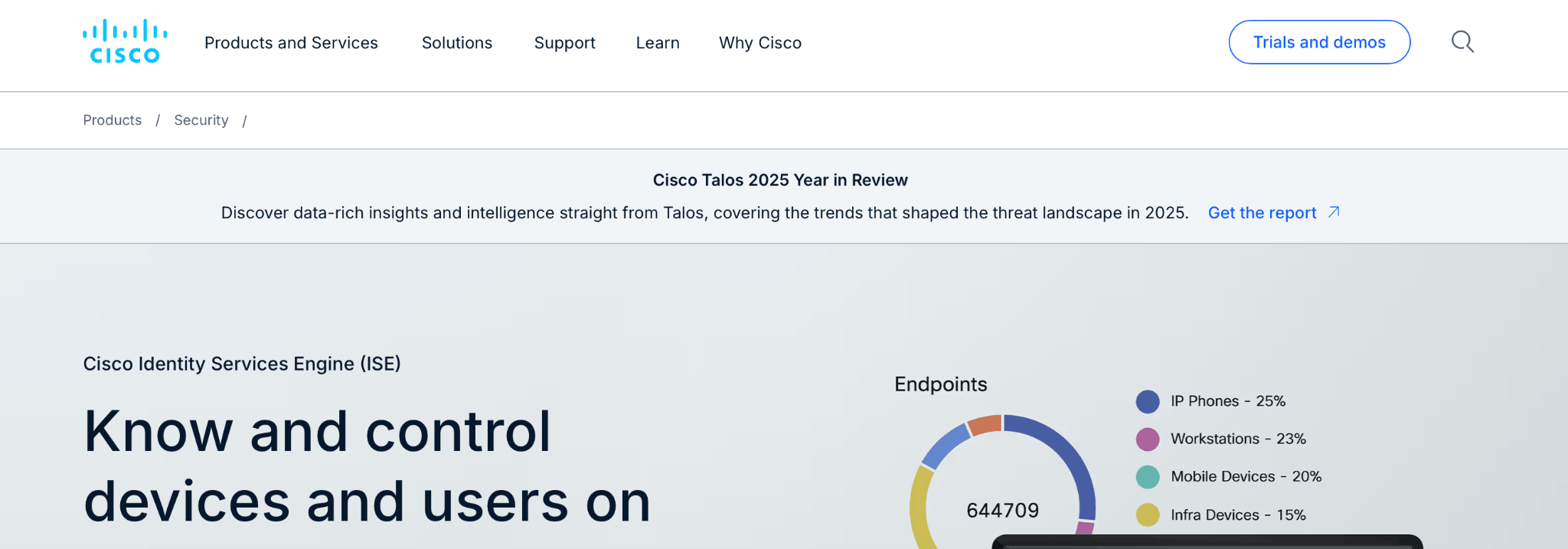
Cisco Identity Services Engine combines network access control with TrustSec segmentation and is deeply integrated into the Cisco ecosystem. Uses Security Group Tags to classify traffic with enforcement through Cisco switches and firewalls. Automated device profiling and SGT assignment integrate with Cisco DNA Center for AI-driven policy recommendations.
- Architecture Approach: Network access control foundation with Software-Defined Access segmentation through Security Group Tags
- Legacy Device Compatibility: Handles medical devices and IoT through profiling services with network-based enforcement without agents
- Deployment Timeline: Implementation requires substantial planning for ISE configuration, SGT assignment, and TrustSec policy creation
- Automation Level: Automated device profiling with SGT assignment and DNA Center integration for AI-driven recommendations
- Integration Ecosystem: Extensive within the Cisco security stack, including Secure Workload, AnyConnect, Umbrella, and SecureX
Summary of Online Reviews |
|---|
Organizations with Cisco infrastructure cite "operational efficiency through unified management and strong dot1x authentication capabilities." Some customers report "complexity in the upgrade process and integration difficulties." |
6. ColorTokens Xshield
ColorTokens delivers SaaS-managed microsegmentation supporting agent-based, agentless, and cloud-native enforcement from a unified console. The multi-model approach uses OS firewalls for agent-based enforcement with network-layer controls for agentless mode. Auto-tagging automatically maps asset metadata and applies policy labels.
- Architecture Approach: Multi-model supporting agent-based OS firewall enforcement, agentless network controls, and cloud-native APIs
- Legacy Device Compatibility: Agentless mode handles OT/IoT devices through network-layer enforcement with automated policy labeling
- Deployment Timeline: SaaS delivery accelerates deployment, with implementation completing within the standard timeline based on the selected model
- Automation Level: Automated asset metadata mapping with auto-tagging and CrowdStrike telemetry-driven policy creation
- Integration Ecosystem: CrowdStrike EDR integration with multi-cloud support and FedRAMP Moderate authorization for federal deployments
Summary of Online Reviews |
|---|
Customers highlight deployment "flexibility through agent-based, agentless, and hybrid enforcement model options managed from a single console." |
7. Forescout
Forescout's platform emphasizes device visibility and control through agentless asset discovery and classification. Network access control foundation extends to segmentation through policy enforcement integrations with existing firewalls and switches. Automated device classification and risk scoring trigger compliance policy-violation remediation workflows.
- Architecture Approach: Agentless asset discovery with network access control policy enforcement through infrastructure integrations
- Legacy Device Compatibility: Strong device profiling across IT, IoT, OT, IoMT, with identification and classification without agents
- Deployment Timeline: Rapid visibility phase with full enforcement deployment requiring policy definition and NAC integration configuration
- Automation Level: Automated device classification with risk scoring and compliance violation remediation workflow triggers
- Integration Ecosystem: Broad ecosystem spanning NAC, firewalls, SIEM, ticketing with Cisco ISE, Palo Alto Networks, and Fortinet support
Summary of Online Reviews |
|---|
Users emphasize "comprehensive asset visibility across diverse device types with accurate profiling," though deployment complexity increases in large, distributed, multi-site environments. |
8. Zero Networks
Zero Networks automates segmentation through network behavior learning with MFA gates for sensitive administrative access. Agentless learning of network traffic patterns eliminates the need for manual policy creation entirely. Admin port controls for RDP, SSH, and WinRM remain closed until MFA verification is complete. Kubernetes segmentation via eBPF was added in October 2025, in partnership with Palo Alto Networks, to automate NGFW customers.
- Architecture Approach: Agentless network traffic learning with MFA-based enforcement gates and eBPF Kubernetes segmentation
- Legacy Device Compatibility: Network-based approach handles devices without agents with rule-based exceptions for non-MFA-capable OT devices
- Deployment Timeline: Advertises rapid full deployment through automated policy creation, eliminating manual engineering effort
- Automation Level: Automatically learns behavior and generates policies with no manual creation required for admin protocol controls
- Integration Ecosystem: Palo Alto Networks' partnership with expanding Kubernetes support is newer than competing solutions
Summary of Online Reviews |
|---|
Users cite the fastest time-to-value among "evaluated solutions with minimal configuration requirements." Some note "limited integrations" compared to established vendors in mature markets. |
Best Network Segmentation for Healthcare & Medical Devices
Best tools for protecting IoMT devices without disrupting clinical operations.
Best Network Segmentation for Manufacturing & OT
Leading platforms for unified IT/OT segmentation and visibility.
Rank | Platform |
|---|---|
1 | |
2 | |
3 | |
4 |
To request a copy of this list in PDF format, contact us here.
CONTACT US HERE