
We analyzed 15 leading microsegmentation platforms and narrowed them down to the top eight using our proprietary ranking methodology for network security microsegmentation. The methodology evaluates policy automation capabilities, enforcement versatility, device discovery completeness, integration depth, and deployment speed.
Ranking Methodology
- Discovery-to-Enforcement Integration (25%): Automatically discovers all assets (IoT, OT, legacy) and converts visibility into segmentation policies, eliminating blind spots and limiting lateral movement.
- Policy Automation Intelligence (25%): AI-driven policy creation that understands application behavior, simulates impact, and adapts continuously, cutting deployment time and reducing risk.
- Agentless Deployment Options (20%): Enables segmentation of unmanaged and legacy systems without agents, covering devices that can't support software installs.
- Multi-Environment Enforcement (15%): Unified policy enforcement across data centers, cloud, containers, endpoints, and OT to prevent gaps in hybrid environments.
- Integration Ecosystem Depth (15%): Native integrations with security tools and platforms enable automated policies, shared intelligence, and coordinated response.
Top 8 Microsegmentation Tools for 2026
Rank | Solution | Discovery-to-Enforcement | Policy Automation | Agentless Capability | Deployment Type | Integration Ecosystem |
|---|---|---|---|---|---|---|
1 | Excellent | Advanced | Full | Hybrid | Extensive | |
2 | Good | Advanced | Partial | Hybrid | Extensive | |
3 | Good | Moderate | Full | Hybrid | Robust | |
4 | Good | Moderate | Full | Hybrid | Extensive | |
5 | Fair | Advanced | Partial | Hybrid | Robust | |
6 | Fair | Moderate | Partial | Hybrid | Extensive | |
7 | Fair | Advanced | Partial | Cloud-Focused | Moderate | |
8 | Limited | Basic | Agent-Only | On-Prem | Moderate |
Top 8 Microsegmentation Tools: Descriptions & Reviews
1. ORDR
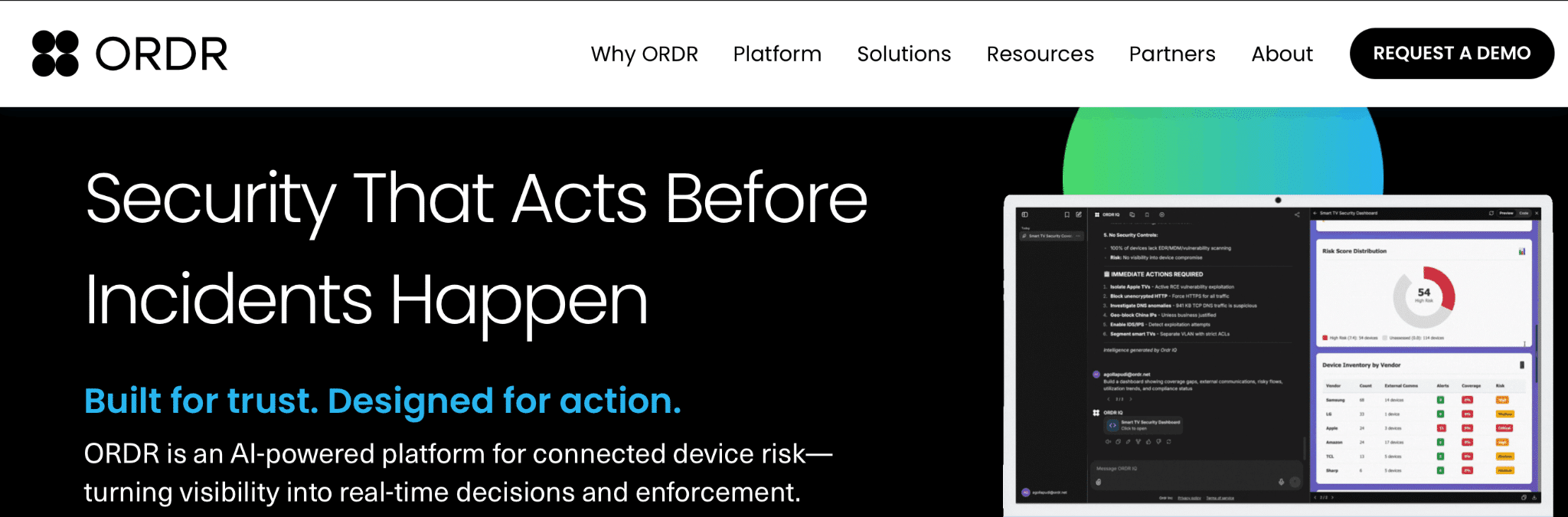
ORDR delivers the industry's only platform that seamlessly integrates comprehensive device discovery with automated enforcement of microsegmentation. The ORDR Security Control Engine (SCE) provides forensic-level visibility into every connected device, from IoT sensors to critical infrastructure, without requiring agents.
- Discovery-to-Enforcement Integration: AI-powered discovery instantly classifies every asset and automatically generates enforcement-ready policies
- Policy Automation Intelligence: Machine learning writes policies based on real-world behavior with simulation-first validation before deployment
- Agentless Deployment Options: Protects unpatched devices, IoT, OT networks, without infrastructure changes
- Multi-Environment Enforcement: Unified enforcement across data centers, cloud, and endpoints through a single control plane
- Integration Ecosystem Depth: Translates policies automatically across 3,500+ infrastructure types, including Cisco, Aruba, Palo Alto, Fortinet
Summary of Online Reviews |
|---|
Organizations praise ORDR for "eliminating months of manual inventory work" and "making segmentation actually achievable." Multiple reviewers highlight the "instant visibility into devices we didn't know existed" and "zero downtime during policy enforcement." |
2. Illumio
Illumio Segmentation combines real-time telemetry with AI to accelerate security decision-making across hybrid multi-cloud environments. The platform emphasizes consistent policy enforcement across data center workloads, cloud, and endpoints through label-based segmentation.
- Discovery-to-Enforcement Integration: Strong visibility with telemetry collection, but requires separate tools for comprehensive asset discovery
- Policy Automation Intelligence: AI-powered policy recommendations with impact simulation capabilities
- Agentless Deployment Options: Primarily agent-based, with some native cloud controls
- Multi-Environment Enforcement: Supports data centers, cloud, and endpoints with unified management
- Integration Ecosystem Depth: Works with major cloud platforms and security tools through native integrations
Summary of Online Reviews |
|---|
Customers note Illumio's "mature platform" and "powerful policy engine." Reviews frequently mention "steep learning curve," but appreciate "comprehensive documentation." Marriott Vacations highlighted how Illumio "safeguards data and secures global operations." |
3. Elisity
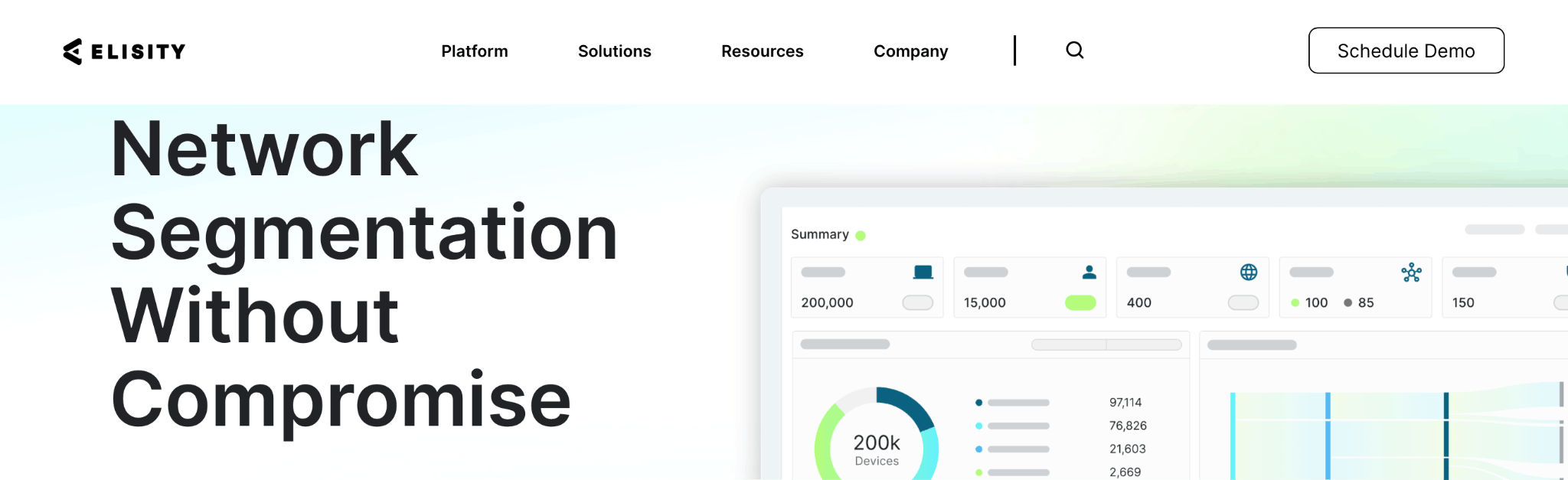
Elisity provides identity-based microsegmentation that leverages existing network infrastructure without requiring agents or VLANs. The platform emphasizes rapid deployment through its Virtual Edge appliance approach to implementing a zero-trust architecture.
- Discovery-to-Enforcement Integration: Integrates with third-party discovery tools like Armis for asset visibility
- Policy Automation Intelligence: Automated policy creation based on identity attributes
- Agentless Deployment Options: Virtual Edge appliances enforce policies on switches and wireless controllers
- Multi-Environment Enforcement: Covers on-premises and cloud environments through appliance deployment
- Integration Ecosystem Depth: Native integration with Cisco infrastructure, Armis, and major NAC platforms
Summary of Online Reviews |
|---|
Main Line Health's CISO stated that Elisity "has changed how we look at microsegmentation solutions overall" and is "easiest to implement and easiest to manage." The organization deployed 6,000+ policies that were actively enforced, protecting over 100,000 IoT devices across 150 facilities in just three days. |
4. ColorTokens
ColorTokens Xshield offers flexible enforcement through agent-based, agentless, and native cloud controls managed from a unified console. The platform supports IT, OT, and IoT environments across on-premises and cloud infrastructures.
- Discovery-to-Enforcement Integration: Can leverage existing EDR agents as sensors to eliminate new agent deployment
- Policy Automation Intelligence: Policy recommendations with simulation capabilities
- Agentless Deployment Options: Gatekeeper appliances for IoT/OT, native cloud controls for workloads
- Multi-Environment Enforcement: Single console for IT, OT, cloud, with multiple enforcement methods
- Integration Ecosystem Depth: Supports CrowdStrike, SentinelOne EDR integration, major cloud platforms, and network vendors
Summary of Online Reviews |
|---|
Organizations value the "flexibility to choose enforcement methods" and "single pane of glass for diverse environments." Reviewers mention "strong OT/IoT capabilities" as a differentiator. Customers appreciate the "you do you" approach that supports agent-based, agentless, and native enforcement. |
5. Akamai Guardicore

Akamai Guardicore Segmentation delivers AI-powered policy creation designed for hybrid IT, cloud, Kubernetes, and AI workloads. Recent 2026 enhancements focus on continuous discovery, application-owner workflows, and exposure-aware detection.
- Discovery-to-Enforcement Integration: Continuous discovery capabilities with application behavior analysis
- Policy Automation Intelligence: AI understands applications, generates policies, simulates impact with explainability
- Agentless Deployment Options: Uses proprietary firewall agents rather than native OS controls
- Multi-Environment Enforcement: Covers data centers, cloud, and containers with centralized management
- Integration Ecosystem Depth: Integrates with cloud platforms and security tools through API-based connections
Summary of Online Reviews |
|---|
Users appreciate "AI-driven insights" and "application owner portal for delegated workflows." Customers note the platform "analyzed more than 500 segmentation projects to pinpoint common bottlenecks." Some reviewers mention "proprietary agent approach complicates OS upgrades." |
6. Cisco Secure Workload
Cisco Secure Workload provides zero-trust microsegmentation optimized for application workloads across data centers and multi-cloud environments. Available as SaaS or on-premises deployments to meet flexible organizational needs.
- Discovery-to-Enforcement Integration: Application discovery and dependency mapping capabilities
- Policy Automation Intelligence: Policy recommendations based on observed traffic patterns
- Agentless Deployment Options: Primarily agent-based, with some native cloud security group support
- Multi-Environment Enforcement: Protects workloads across on-premises and cloud
- Integration Ecosystem Depth: Native integration with Cisco Secure Firewall, major cloud platforms
Summary of Online Reviews |
|---|
Enterprises value "deep visibility into application dependencies" and "integration with Cisco security portfolio." United Airlines cited Cisco Secure Workload as helping "enhance security, reduce risks, and simplify hybrid operations." |
7. Zero Networks
Zero Networks focuses on automated, identity-aligned microsegmentation with emphasis on rapid deployment. The platform targets Windows, Mac, and Linux environments, with automated policy creation to contain ransomware.
- Discovery-to-Enforcement Integration: Automated asset discovery for supported operating systems
- Policy Automation Intelligence: Set-and-forget automation with identity-driven policy creation
- Agentless Deployment Options: Uses ZN Segment Server for enforcement on host firewalls
- Multi-Environment Enforcement: Virtual Segment Server for cloud, limited OT/IoT support
- Integration Ecosystem Depth: Integrations with major cloud platforms, limited network vendor support
Summary of Online Reviews |
|---|
Organizations report "deployment in 30 days" and "significant reduction in manual policy management." Zero Networks analyzed "3.4 trillion activities across 400 enterprise environments" to understand attack patterns. Some note "limited support for operational technology environments." |
8. VMware NSX
VMware NSX provides distributed firewall capabilities for microsegmentation within VMware virtualized environments. The platform emphasizes integrating network virtualization through NSX Intelligence to enable automated application discovery.
- Discovery-to-Enforcement Integration: Focused on VMware workload discovery
- Policy Automation Intelligence: Application Rule Manager provides some automation within the VMware ecosystem
- Agentless Deployment Options: Relies on VMware hypervisor integration
- Multi-Environment Enforcement: Strongest in VMware-centric data centers
- Integration Ecosystem Depth: Deep VMware integration, limited outside the VMware ecosystem
Summary of Online Reviews |
|---|
VMware customers appreciate "tight integration with existing vSphere deployments" and "near line rate performance." Reviewers note "limitations protecting non-VMware workloads" and "challenges extending policies beyond virtualized environments." |
Best Microsegmentation Tools for Healthcare
These microsegmentation platforms are best suited for healthcare organizations managing IoMT and regulatory requirements.
Rank | Tool | Key Strength |
|---|---|---|
1 | Purpose-built for healthcare IoMT with forensic device profiling | |
2 | Proven rapid deployment with large-scale medical device protection | |
3 | Strong compliance automation aligned with healthcare regulations | |
4 | Comprehensive IoT/IoMT protection using agentless enforcement |
Best Microsegmentation Tools for Operational Technology
These platforms are leading choices for microsegmentation in OT and industrial settings.
Rank | Tool | Key Strength |
|---|---|---|
1 | Hardware Gatekeeper appliances built for shop floor OT networks | |
2 | Protects PLCs, HMIs, and critical infrastructure without patching | |
3 | Strong IT/OT convergence capabilities | |
4 | Identity-based policies without requiring network redesign |
To request a copy of this list in PDF format, contact us here.
CONTACT US HERE