Our Ranking Methodology
- Identity Verification (20%): How platforms authenticate users and devices, validate posture, and enforce risk-based multi-factor authentication.
- Microsegmentation (25%): The ability to enforce granular, device-level access policies that isolate workloads and prevent lateral movement.
- Continuous Monitoring (20%): Real-time visibility into device behavior, anomaly detection, and telemetry across managed and unmanaged assets.
- Policy Enforcement (15%): How effectively platforms translate security policy into automated, least-privilege action across hybrid environments.
- Unmanaged Device Coverage (20%): Whether platforms secure IoT, medical, and agentless endpoints through passive discovery without requiring software installation.
Top 8 Zero Trust Platforms for 2026
Rank | Platform | Identity Verification | Segmentation & Access Control | Monitoring & Visibility | Policy Enforcement | Unmanaged Device Visibility |
1 | Continuous user and device validation | Granular device-level segmentation | Full visibility across managed and unmanaged assets | Adaptive, risk-based enforcement | Extensive coverage of IoT, OT, and unmanaged devices | |
2 | Strong identity-driven access controls | Application-level segmentation | Strong user and session monitoring | Centralized policy enforcement | Limited unmanaged device visibility | |
3 | Context-aware user and device verification | Advanced network segmentation | Broad network and application visibility | Consistent risk-based controls | Moderate unmanaged asset visibility | |
4 | Continuous authentication and identity integration | Application-focused access controls | Strong access activity visibility | Edge-based policy enforcement | Limited unmanaged device visibility | |
5 | Identity and endpoint trust validation | Basic segmentation capabilities | Excellent endpoint monitoring and detection | Threat-informed enforcement | Moderate unmanaged asset visibility | |
6 | Identity-integrated access controls | Strong network-based segmentation | Unified user and device visibility | Consistent enterprise policy management | Moderate unmanaged device visibility | |
7 | Identity-aware access controls | Integrated network segmentation | Strong network visibility | Centralized security enforcement | Moderate unmanaged device visibility | |
8 | Advanced identity and conditional access | Primarily identity-based segmentation | Strong user and access visibility | Granular conditional access policies | Limited unmanaged device visibility |
Top 8 Zero Trust Platforms: Descriptions and Reviews
1. ORDR
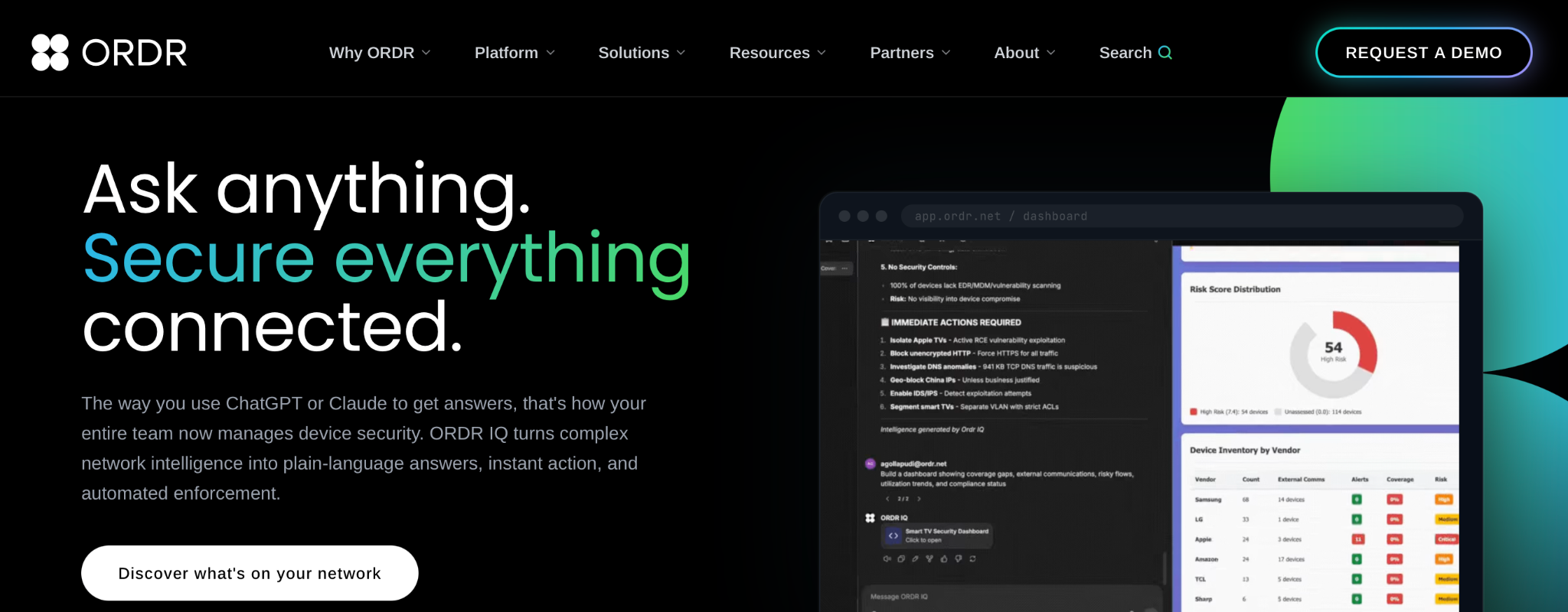
ORDR is the only zero-trust platform purpose-built for unmanaged and agentless devices, including IoT, OT, and IoMT endpoints. Its Systems Control Engine passively discovers every connected device, builds behavioral baselines in 24 to 72 hours, and turns that intelligence into enforced microsegmentation through your existing firewall and NAC infrastructure.
- Identity Verification: Multi-layered device authentication with continuous behavioral validation across managed and unmanaged assets.
- Microsegmentation: Device-level policies generated from live traffic and validated through simulation before enforcement.
- Continuous Monitoring: Real-time visibility across every IT, IoT, OT, and IoMT asset with device-level anomaly detection.
- Policy Enforcement: Automated enforcement pushed through existing Cisco, Palo Alto, Fortinet, and Aruba infrastructure.
- Unmanaged Device Coverage: The only platform on this list built from the ground up to secure agentless devices without disrupting operations.
Summary of Online Reviews |
Customers call ORDR "a great purpose-built product that delivers exactly what they promise" and praise its "ability to secure medical devices and IoT without disrupting operations." |
2. Zscaler

Zscaler Zero Trust Exchange connects users directly to applications using identity-based policies, eliminating the VPN model entirely. It earned a 2025 Gartner Peer Insights Customers' Choice distinction for Security Service Edge.
- Identity Verification: Risk-based authentication that continuously validates user access rather than relying on a single session check.
- Microsegmentation: Application-level segmentation granting users access only to specific authorized resources, not network segments.
- Continuous Monitoring: Inline SSL inspection and cloud-delivered threat detection across all user traffic.
- Policy Enforcement: Cloud-native enforcement at scale for distributed, remote, and hybrid workforces.
- Unmanaged Device Coverage: Primarily optimized for managed user devices; limited support for IoT and agentless endpoints.
Summary of Online Reviews |
Users call Zscaler a "true ZT" that "constantly validates" access, though enterprise teams note that licensing separate functions adds cost. |
3. Palo Alto Networks

Palo Alto Networks delivers zero trust through Prisma Access, combining ZTNA 2.0 with NGFW, CASB, and DLP in a single console. It was recognized as a 2025 Gartner Peer Insights Customers' Choice for Security Service Edge.
- Identity Verification: Conditional access with deep identity provider integration across remote users and branch offices.
- Microsegmentation: Granular firewall-based workload protection with ZTNA 2.0 controls across cloud and on-premises.
- Continuous Monitoring: Unified telemetry from network and endpoints with Cortex XDR-powered AI threat detection.
- Policy Enforcement: Centralized management via Strata Cloud Manager for SASE deployments at global scale.
- Unmanaged Device Coverage: Stronger for managed infrastructure; microsegmentation for unmanaged assets requires additional tooling.
Summary of Online Reviews |
Reviewers praise "strong visibility and seamless integration," though smaller teams note initial deployment complexity. |
4. Cloudflare
Cloudflare One routes identity-verified, application-level access through a global edge network spanning 300-plus cities. Cloudflare Access holds a 4.5 out of 5 rating across 200+ verified Gartner reviews.
- Identity Verification: SSO and contextual access controls with MFA enforcement at the network edge.
- Microsegmentation: Per-application access without exposing network segments, for web and non-web applications.
- Continuous Monitoring: Global threat intelligence at the edge with unified logging across all traffic.
- Policy Enforcement: Fast policy propagation across Cloudflare's edge network through a single dashboard.
- Unmanaged Device Coverage: Designed for managed user devices; OT and IoT coverage is limited.
Summary of Online Reviews |
Customers say Cloudflare works "well built and easy to deploy," though enterprise teams note that policy management at scale and premium features add complexity. |
5. CrowdStrike
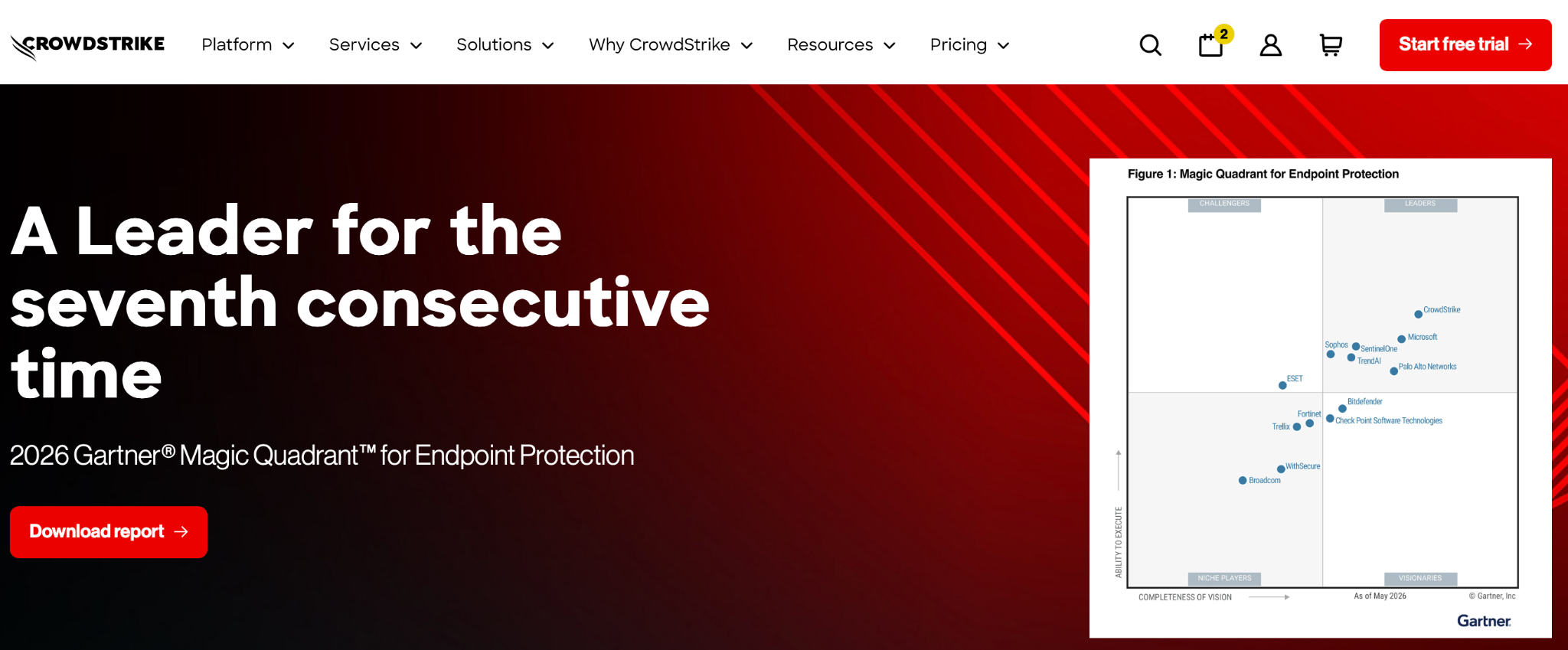
CrowdStrike Falcon Zero Trust combines endpoint telemetry with identity intelligence for continuous device and user risk assessment. It earned a 2026 Gartner Peer Insights Customers' Choice for Endpoint Protection with a 97% willingness-to-recommend rating.
- Identity Verification: Real-time risk scoring based on live endpoint behavior with continuous posture validation.
- Microsegmentation: Endpoint-focused controls; strongest in managed device environments rather than network-wide segmentation.
- Continuous Monitoring: Industry-leading endpoint detection with 24/7 AI-driven telemetry and anomaly identification.
- Policy Enforcement: Risk-based access control through the Falcon platform and select partner integrations.
- Unmanaged Device Coverage: Agent-dependent approach limits IoT and OT coverage compared to purpose-built platforms.
Summary of Online Reviews |
Teams credit CrowdStrike with "reducing a lot of noise," though it performs better as a signal source than a standalone enforcement tool. |
6. Cisco Secure Access
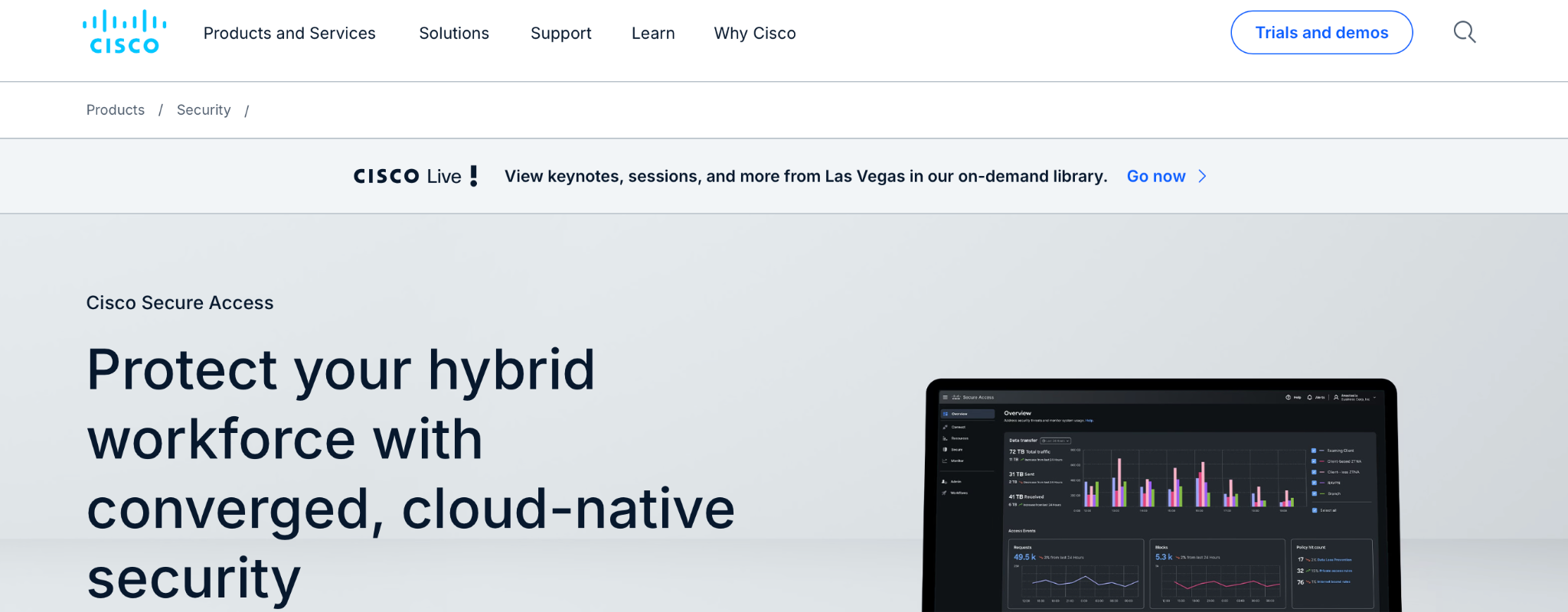
Cisco Secure Access converges ZTNA, SWG, and CASB into a cloud-delivered SSE platform with native integration across Cisco SD-WAN, Meraki, Duo, and XDR.
- Identity Verification: Context-aware access with user and device posture checks and native Duo MFA.
- Microsegmentation: Application-layer controls across hybrid cloud and on-premises in a unified console.
- Continuous Monitoring: Integrated telemetry across Cisco's portfolio with centralized visibility into all traffic.
- Policy Enforcement: Single SSE policy engine covering internet access, private apps, and threat prevention.
- Unmanaged Device Coverage: Well-suited for enterprise IT; less optimized for IoT and OT ecosystems.
Summary of Online Reviews |
Reviewers say it "works for branches, remote users, and cloud applications,” though licensing complexity across SSE tiers can be a friction point. |
7. Fortinet
Fortinet Universal ZTNA is the only vendor recognized as a 2025 Gartner Peer Insights Customers' Choice specifically for Zero Trust Network Access, earning a 4.9 out of 5 rating across 307 verified reviews.
- Identity Verification: Policy-driven MFA with continuous risk assessment tied to the Fortinet Security Fabric.
- Microsegmentation: Application segmentation across cloud and data center, strongest within FortiGate and FortiSwitch environments.
- Continuous Monitoring: Security Fabric visibility across the Fortinet ecosystem; behavioral AI maturity trails dedicated enforcement platforms.
- Policy Enforcement: End-to-end enforcement for FortiClient, FortiGate, and FortiSwitch environments.
- Unmanaged Device Coverage: Agent-based model limits IoT and OT coverage; best in Fortinet-native deployments.
Summary of Online Reviews |
Customers highlight "strong security enforcement and smooth integration with Fortinet products," though mixed-vendor organizations note the platform delivers its strongest value when fully standardized on the Fortinet stack. |
8. Microsoft Entra

Microsoft Entra provides identity-driven zero trust through Global Secure Access, enforcing risk-based Conditional Access policies across Microsoft 365 and integrated applications. The platform has been a Gartner Magic Quadrant Leader for Access Management for nine consecutive years.
- Identity Verification: Deep Azure AD integration with Conditional Access, MFA, and identity governance across cloud and hybrid environments.
- Microsegmentation: Application-focused controls; device-level segmentation for non-Microsoft infrastructure requires supplemental tools.
- Continuous Monitoring: Extensive logging and audit capabilities across the Microsoft ecosystem.
- Policy Enforcement: Native enforcement for Microsoft services with SAML and OIDC support for third-party providers.
- Unmanaged Device Coverage: Optimized for managed Windows and cloud-first devices; limited IoT, OT, and agentless support.
Summary of Online Reviews |
Customers say Entra "fits naturally into the Microsoft ecosystem,” though non-Microsoft environments consistently require additional tools to fill coverage gaps. |
Best Zero Trust Platforms for Healthcare and IoT Security
Rank | Platform |
1 | |
2 | |
3 | |
4 |
Best Zero Trust Platforms for Enterprise Remote Access
Rank | Platform |
1 | |
2 | |
3 | |
4 |
To request a copy of this list in PDF format, contact us here.